Tuesday, September 16, 2008

Hearing


Many arthropods and nearly all vertebrates have acoustical organs and so can hear sounds. For example, humans and other land-dwelling mammals have a pair of distinctive ears. Small organs, flush with the body surface, serve comparable functions in insects and amphibians. Such organs are located on the front legs of crickets and near the hind legs of grasshoppers.

Hearing starts with acoustical receptors, which are vibration-sensitive mechanoreceptors. A vibration is a wavelike form of mechanical energy. For example, clapping produces waves of compressed air. Each time hands clap together, molecules are forced outward, so a low-pressure state is created in the region they vacated. The pressure variations can be depicted as a wave form, and the amplitude of its peaks corresponds to loudness. They frequency of a sound is the number of wave cycles per second. Each cycle extends fro the start of one wave peak to the start of the next. The more cycles per second, the higher the frequency, and the higher the perceived pitch of the sound.

When sound waves arrive at an acoustical organ, they encounter a membrane and make it vibrate. In invertebrates, vibrations directly stimulate mechanoreceptors attached to the membrane. In vertebrates, the membrane vibrations cause a fluid inside the ear to be displaced. The fluid movement causes mechanoreceptors to bend. With enough deformation, action potentials are produced. They travel along an auditory nerve leading from the receptors to the brain.

The introduction to this chapter described the sense of hearing that is associated with echolocation. Although we cannot hear them, the extremely high frequency waves (ultrasound waves) produced by an echolocating bat are not weak. They have been measured at 100 decibels which is in the same range as thunder or a freight train racing past.

Bear in mind, bats are not the only echolocating animals. Dolphins and whales also emit ultrasounds, which travel through their marine environments. By perceiving frequency variations in the echoes, all of these mammals also can pinpoint the distance and direction of movement of one another and of predators or pray.

Sunday, September 14, 2008

Cloaning


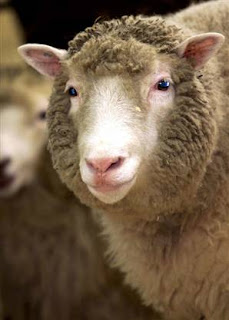
In 1996 scientists in Scotland cloned a sheep, which they named Dolly. They did this by taking a body cell from an adult sheep and using its DNA to make an exact copy f that sheep. In the future cloning could allow scientists to produce tailor-made body organs for transplant patients, or create whole herds of cows or sheep that produce useful drugs in their milk. The technique could also be used to enable infertile couples to have a child who would be a clone of one of them.

1953 – Francis Crick and James Watson discover the structure of DNA

1973 – Stanley Cohen and Herbert Boyer carry out first Genetic Engineering with bacteria

1986 – Human Genome project set up to list sequence of entire human genome

1990 – First trials for ‘Gene Therapy’

1996 – Dolly, a cloned sheep, created by Roslin Institute Scotland

2000 – First draft of human genome published.

Wednesday, September 10, 2008

D4 syndrome


D4 syndrome is commonly known as middle back pain. The patients affected by this syndrome have pain between neck and the lumbar region (Lower back). Initially the pain occurs in the central position of the back, then gradually spreads to the lateral portion (side) of the chest. In some cases the pain may even be felt in the centre of chest causing breathing difficulty.

Reason: While driving we tend to berid a little forward coupled with this when the vehicle jolts in a pit it forces out body to bend downwards causing the posterior back ligament to stretch and lose its elasticity. The inter vertebral disc can also slip posteriorly (back wards) and it compresses the spinal cord causing pain. Whenever normal positioning of the bone is disturbed out body tends to deposit osteophytes (bone forming cells). This deposition of osteophytes compresses the nerves which branch from the spinal cord causing radiating pains in the chest. If this osteophytes compress the respiratory nerves, the patient will get some breathing problem. Problem similar to above can also be caused by wrong posture.

Bending forward creates angulation in the 4th thoracic vertebra (middle back) resulting pain in scapula region. Thus it is called D4 syndrome.

Treatment: In combined therapy, homoeopathic medicines, machines like shortwave diathermy ultrasound and special manipulation techniques are used. In physiotherapy ultrasound and shortwave diathermy are the effective treatment to remove the osteophytes. The vibration from the ultrasound and the electromagetic waves from the shortwave diathermy remove the osteophytes.

In addition, by effective manipulation we can rearrange the vertebrae to normal alignment. To maintain the normal positioning of the vertebrae the patient should do muscle strengthening exercises regularly. In these cases, traction treatment is not effective. Homeopathic medicines like Kali carb, pulsatilla, Cal Carb. Rhus tox can reduce the pain and inflammation immediately. They prevent the recurrence also.

Friday, August 29, 2008

Tissue and Organ Formation

The tissues just described form organs and organ systems that are much the same in all vertebrates. To get a general sense of how this happens, start with a sperm and egg. Recall that these develop from germ cells, which are immature reproductive cells. (All other cells in the body are “somatic”, after the Greek word for body.) After a zygote forms at fertilization, mitotic cell divisions produce an early animal embryo. In vertebrates, the cells soon become arranged as three primary tissues-ectoderm, mesoderm, and endoderm. These are embryonic forerunners of all tissues in the adult. Ectoderm gives rise to the skin’s outer layer and to tissues of the nervous system. Mesoderm gives rise to the tissues of muscle, bone, and most of the circulatory, reproductive, and urinary systems. Endoderm gives rise to the gut’s lining and organs derived from it.

You might think we are stretching things a bit when we say that each one of those systems contributes to the survival of all living cells in the body. After all, what could the body’s bones and muscles have to do with the life of a tiny cell? Yet interactions between the skeletal and muscular systems allow us to move about toward sources of nutrients and water, for example. Parts of those systems assist blood circulation, as when contractions of leg muscles help move blood in veins back to the heart. The bloodstream transports nutrients and other substances to individual cells, and transports secreted products and wastes away from them.

MUSCULAR SYSTEM
Movement of internal body parts movement of whole body maintenance of posture heat production.

INTEGUMENTARY SYSTEM
Protection from injury, dehydration, and some microorganisms; control of body temperature; excretion of some wastes; reception of external stimuli.

NERVOUS SYSTEM
Detention of external and internal stimuli control and coordination of responses to stimuli integration of activities of all organ systems.

URINARY SYSTEM
Maintenance of the volume and composition of extracellular fluid. Excretion of blood-borne wastes.

SKELETAL SYSTEM
Support, protection of body parts sites for muscle attachment, body cell production, and calcium and phosphate storage.

CIRCULATORY SYSTEM
Rapid internal transport of many materials to and from cells helps stabilize internal temperature and pH.

REPRODUCTIVE SYSTEM
Male: Production and transfer of sperm to the female. Female: Production of eggs provision of a protected, nutritive environment for developing embryo and fetus. Both systems have hormonal influences on other organ systems.

RESPIRATORY SYSTEM
Delivery of oxygen to cells removal of carbon dioxide wastes produced by cells pH regulation.

DIGESTIVE SYSTEM
Ingestion of food, water preparation of food molecules for absorption elimination of food residues from the body.

LYMPHATIC SYSTEM
Return of some tissue fluid to blood roles in immunity (defense against specific invaders of the body).

ENDOCRINE SYSTEMHormonal control of body functioning works with nervous system in integrative tasks.

Wednesday, August 27, 2008

Bacteria And Viruses


The unseen multitudes

Did a friend even mention that you are nearly 1/1000 of mile tall? Probably not. What would be the point of measuring people in units as big as miles? Yet we think this way, in reverse, when we measure microorganisms. These are mostly single-celled organisms too small to be seen without a microscope.

Of all organisms, bacteria generally are the smallest. To be sure, viruses are smaller. We measure them in nanometers (billionths of a meter). But viruses are not living things. We consider them here because they infect just about every kind of organism in the great spectrum of life.
1. Bacteria are microscopically small, single-celled prokaryotic organisms. They do not have a profusion of internal, membrane-bound organelles in the cytoplasm, as eukaryotic cells do. Yet bacteria show great metabolic diversity, and many make complex behavioral responses to the environment.
2. Today there are two great bacterial lineages, the archaebacteria and dubacteria. Archaebacteria live in such inhospitable, anaerobic habitats that they may resemble the first living cells on earth. Most bacterial species are eubacteria, which inhabit nearly all existing environments.

3. Bacteria reproduce by binary fission, a cell division mechanism that immediately follows DBA replication and that divides the parent cell into two genetically equivalent daughter cells.
4. Nearly all viral multiplication cycles include five steps: attachment to a suitable host cell, penetration, viral DNA or RNA replication and protein synthesis, assembly of new viral particles, and release from the infected cell.

Tuesday, August 26, 2008

Do you know about thyroid functioning and parathyroid functioning


Thyroid functioning

The human thyroid gland is at the base of the neck in front of the trachea, or windpipe. It is main hormones, thyroxine and triiodothyronine, have widespread effects on most cells. They are critical for normal development of many tissues, and they control overall metabolic rates in humans and other warm-blooded animals. Their importance is brought into sharp focus by cases of abnormal thyroid secretion.

The synthesis of thyroid hormones requires iodine, which is obtained from the diet. In the absence of iodine, blood levels of these hormones decrease. The anterior pituitary responds to this by secreting a thyroid stimulating hormone (TSH). Because the thyroid hormones cannot be synthesized, the feedback signal continues and so does TSH secretion. Excess TSH overstimulates the thyroid gland and causes it to enlarge. The enlargement is a form of goiter. Goiter caused by iodine deficiency is no longer common in countries where people use iodized salt.

Hypothyroidism results from insufficient concentrations of thyroid hormones. Hypothyroid adults often are overweight, sluggish, dry-skinned, intolerant of cold, and sometimes confused and depressed. Affected women often have menstrual disturbances. Hyperthyroidism results from excess concentrations of thyroid hormones. Hyperthyroid adults show an increased heart, rate, elevated blood pressure, weight loss despite normal caloric intake, intolerance of heat, and profuse sweating. Typically they are nervous, agitated, and have trouble sleeping.

Parathyroid functioning

Some endocrine glands do not respond directly to other hormones or nerves. They respond homeostatically to chemical change in the immediate surroundings. The parathyroid glands are like this. Four such glands are positioned next to the back of the human thyroid. They secrete parathyroid hormone (PTH) when the concentration of calcium ions in their surroundings decreases. Their action affects how much calcium is available for enzyme activation, muscle contraction, blood clotting, and many other tasks.

PTH stimulates bone cells to release calcium and phosphate ions, and stimulates the kidneys to conserve them. PTH also helps activate vitamin D. The activated form, a hormone, enhances calcium absorption from ingested food. In vitamin D deficiency, too little calcium and phosphorus is absorbed, so bones develop improperly. This ailment is called rickets.

Hormonal responses to the external environment influence growth, development, and reproduction in predictable ways. The pineal gland, a photosensitive organ in the brain, provides a good example of this. In the absence of light, the pineal gland secretes the hormone melatonin. Thus bood levels of melatonin vary from day to night, and they vary with the changing seasons. The variations influence the development of primary reproductive cycles and reproductive behavior in a variety of species.

Consider the hamster. In winter, when nights are longest, melatonin levels are high and sexual activity is suppressed. In summer, when days are longer, melatonin levels are low-and hamster sex peaks. Or consider a male white-throated sparrow. Melatonin suppresses growth of the bird’s gonads until spring, when days start to lengthen. Then, stepped-up gonadal activity leads to the production of hormones that influence singing behavior. With his distinctive song, the sparrow defines his territory and may hold the interest of a mate.
Does melatonin also influence human behavior? Perhaps, it seems possible that decreased melatonin secretion triggers puberty, the age at which human reproductive organs and structures start to mature. In cases where disease has destroyed the pineal gland, puberty begins prematurely, the focus essay mentions some other interesting possibilities.

Thursday, August 21, 2008

Do You need Alcohol?

You can make alcohol from almost anything edible. Through a process called fermentation, sugars are converted into ethanol alcohol. This chemical is readily absorbed into the bloodstream and has a powerful effect on the body and mind. Stronger alcohol, called sprits, and often called hard liquor, are made through distillation in which alcohol is heated to concentrate the ethanol. Eifferent societies use different ingredients and processes to make alcohol. In southern Europe, grapes are traditinally fermented to make wine-a process first introduced by the Romans.

Nothern European countries are famous for their beers brewed from grain and hops. Grapes are also the main ingredient of another famous French spirit called brandy. Other spirits include gin, vodka, and whisky.

How to affect the body?
Although it comes in different forms and strengths, alcohol has basically the same effects when you drink it. At first these may be pleasant. You may feel rather warm, light-headed, and relaxed.

However, the more you drink, the worse you will feel. As more alcohol enters your bloodstream, you will find it increasingly difficult to perform physical tasks. You will lose your coordination and sense of balance, knocking things over and feeling unsteady on your feet. Your speech will become slurred and difficult for other people to understand.

If you drink a lot very quickly, alcohol can kill. It can affect the brain so badly that the heart or breathing stops. Drinking too much can make people feel very sick the next day, and it can take days for their bodies to recover.

Liver?
The liver is the organ in your body that breaks down and eliminates poisons like alcohol. It has been likened to a car with one gear that just goes at one speed-the liver can burn up only one unit of alcohol an hour. Liver cells that have too much alcohol to process die and are replaced by fatty tissue.

Drinkig heavily over a number of years puts great strain on the liver, which can become so scarred that it no longer works properly. This is known as cirrhosis. Heavy drinking also contributes to other conditions like heart disease, hepatitis, and stomach problems such as bleeding and ulcers. It can cause men to become sexualy impotent and by interfering with th ebalance of hormones in the body alcohol increases the risk of breast cancer in women. Mothers who drink heavily when pregnant can severely damage their unborn children.

People who drink heavily for a long time can become addicted to alcohol. those who develop an emotional or physical dependency on drink are known as alcoholics. Alcoholism usually takes years to develop. Early signs include constantly needing to have liquor available and being unusually resistant to its effects. In the later stages, however, people gradually lost control over their drinking. Alcoholics often suffer from unpleasant conditins like shaking, various body pains, and redness in the face. They can experience severe withdrawal effects if they suddenly stop. Unlike coming off other drugs, sudden alcohol withdrawal can actually kill.

Treatment programs for alcohol addiction can be very effective. Some people go to drying out clinics for help, others join groups like Alcoholics Anonymous for support in giving up alcohol. Alcoholics Anonymous has over two million members throughout the world.

Wine cooler - This is fruity drink with alcohol added (alcohol content is 4%-8% only)

Beer - This is Fermented mixture of grains and water (alcohol 3%-10% only)

Wine - This is Fermented grape juice (alcohol content 8%-14% only)

Liqueurs - This is sweetened and flavored spirits (alcohol content 20%-40%)

Spirits _ This is alcoholic drink concentrated by distillation (alcohol 38%-45%)